Showing posts with label Concept Car. Show all posts

Thursday, January 6, 2011

2010 Ford GT90 Super Sport Car Concept going to auction

2010 Ford GT90 Super Sport Car Concept

If Ford first introduced the GT90 Concept at the 2010 Detroit Auto Show next month, it would still be one of the most eyecatching cars on the show floor. What's amazing is that Ford unveiled the GT40 successor nearly 15 years ago. What's more, even by today's standards it's still a supercar among supercars.
The quad-turbocharged 6.0-litre V12 puts out an estimated 720 horsepower, the body is constructed completely of carbon fiber and top speed is somewhere in the 400 kph range. The only hints that it's not a modern supercar are the all-blue interior and wheels that look dated now.
So what's all the fuss about the GT90 Concept now? RM Auctions in the States has just announced that it will be offering the concept car at its upcoming Arizona sale. That's right, this is your chance to own one of the coolest concept vehicles of all time. This is the first time that the GT90 Concept has ever been publicly for sale at auction, and RM claims that it is in "excellent running condition, having been properly stored and maintained over the year." No estimated on price is given, but we're guessing it will take a large suitcase of cash to take the car home.
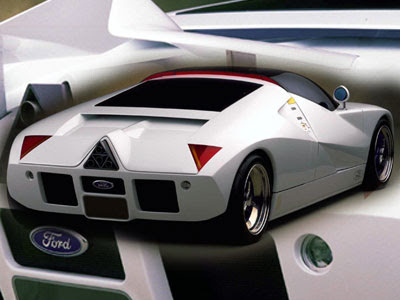
2010 Ford GT90 Super Sport Car Concept

The one-off GT90 Concept Car, labeled immediately as "the world's mightiest supercar" by Ford Motor Company on December 6, 1994, was the spiritual successor to the Ford GT40, the product of a colossal feud in the early 1960s between the Blue Oval from Dearborn and the Prancing Horse of Northern Italy. The GT90 draws from the design cues of its heritage and pays homage to the famed Le Mans-winning Ford GT40s of the 1960s, which were created after the failed attempt by Ford to buy out Ferrari.
At a development cost in the neighborhood of $3 million, the GT90 was certainly worthy of pulling styling cues from the original Ford GTs, and although it was never meant for production, it was built according to a Ford press release as a "test bed for technology, engineering and design concepts, and driver-oriented features that eventually may be used in Ford production vehicles."
Officially unveiled to the public in January 1995 at the Detroit Auto Show, the GT90 is finished in bright white with a bright blue and carbon fiber interior. It features a mid engine quad-turbocharged V12 that produces an estimated 720 horsepower and 660 pound-feet of torque. As a result, it had a claimed top speed of 253 mph, which even by today's standards would make it one of the fastest production cars in the world – faster even than a McLaren F1, which was widely considered the world's preeminent supercar at the time.
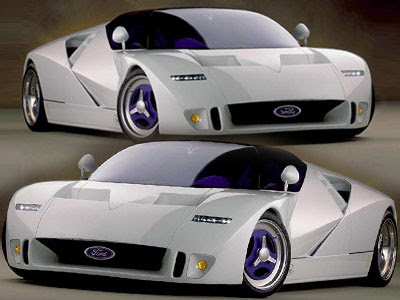
2010 Ford GT90 Super Sport Car Concept

The engine, which was a 48-valve six-liter V12, had to be combined together with four Garrett Systems T2 turbochargers in order to reach its estimated 720 horsepower and was based on the Ford Modular engine. Created by using parts of two Lincoln V8 engines, engineers removed the last pair of cylinders from the rear of one engine and the first pair of cylinders from the front of the other engine. The cut-down engines were then welded together with the final result being a 90-degree V12, which utilized a 90.2 mm bore and a 77.3 mm stroke to achieve maximum power.
The GT90 features the FFD-Ricardo five-speed manual gearbox found on the XJ220 and, considering the torque load that it is designed to handle, is noted as having a relatively light shift quality. Also borrowed from the XJ220 comes the all around double wishbone suspension that was designed to enable the car to handle well at top speeds.
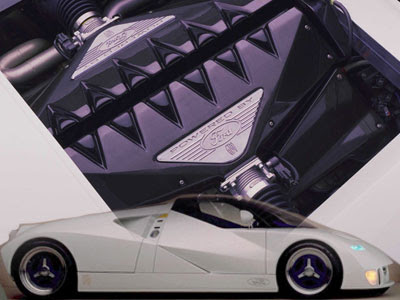
2010 Ford GT90 Super Sport Car Concept

Using Ford's new "Edge" design philosophy, the car incorporated advanced technology with a mixture of flat planes, angles, glass and triangular shapes that seemingly all collided together. The GT90 was the first car created using this new styling directive from Ford, which went on to be responsible for the creation of other Ford products like the Ka and Cougar. The effect is most impressive and a wonderfully executed stylistic throwback to its GT40 predecessor, which at once stays true to its heritage but acknowledges the advances in modern design. Taken directly from race car technology, the GT90 body panels are molded out of carbon fiber while the chassis is formed out of a honey-comb sectioned aluminum monocoque.
The GT90 is a test bed of advanced technology and design. It sports a tinted, laminated glass bubble over the cockpit and a spoiler that rises off the rear deck at high speeds. According to Ford, it has a "design that tightly enclosed its mechanicals with no wasted space; high tech lighting and blind-spot detection systems; and tiles like those on the space shuttle to shield the V12's exhaust outlets."
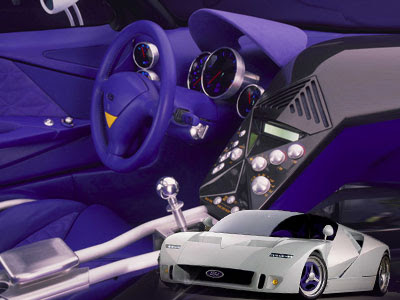
2010 Ford GT90 Super Sport Car Concept

After its unveiling in Detroit, the GT90 made its rounds on the Auto Show Circuit in 1995, traveling around the world to Frankfurt and as far away as Tokyo. With few other showings in between, the car recently was shipped over to Europe to be on display in the Ford of Europe 2008 exhibit at the Goodwood Festival of Speed. After returning home, the car was shipped to Alabama where it was on display as part of the Mustang 45th Anniversary Celebration.
This superb concept car remains in excellent running condition, having been properly stored and maintained over the years in between its show appearances. RM Auctions is proud to publicly offer the GT90 for the first time ever at auction. A remarkable one-off piece of automotive history and cutting-edge design, its offering may very well be a once in a lifetime opportunity for Ford devotees and concept car enthusiasts.
READ MORE - 2010 Ford GT90 Super Sport Car Concept going to auction

Monday, January 3, 2011

Astrum Meera Sport Cars Concept Created by Skyrill Design


Astrum Meera Sport Cars Concept Created by Skyrill Design
Concept cars have an unique way to make us dream of the future. Taking cues from the crop of levitating designs that have risen in the last little while, the Astrum Meera is a car concept that uses magnetic technology lighten the entire frame. That's exactly what the Astrum Meera does: puts you in a world where technology and design walked a long path and found perfect balance.
Astrum Meera Sport Cars Concept Created by Skyrill Design
Created by Skyrill Design Studios from Bahrain, the “Astrum Meera” is a car concept that incorporates distinctive features in a rather practical design to offer a safe and sustainable ride in the days to come. Astrum Meera’s frame is essentially suspended slightly above the tires, which continue to stay grounded to the pavement.
Astrum Meera Sport Cars Concept Created by Skyrill Design, the side mirrors are hidden when parked and roll out of the body once the engine starts. The mirrors have a built-in camera system that allows the driver to clearly see outside from inside the vehicle without opening windows in the rain or turning your head around.
Astrum Meera Sport Cars Concept Created by Skyrill Design
Astrum Meera Sport Cars Concept Created by Skyrill Design running on wheel rims that work through magnetic levitation, similar to train wheels, to make it lighter and faster, the futuristic vehicle integrates the exhaust with built-in sensors, which track the level of CO2 emissions and alert the driver as it goes beyond the normal range. As far as futuristic vehicles go, this one is pretty impressive.
Astrum Meera Sport Cars Concept Created by Skyrill Design
READ MORE - Astrum Meera Sport Cars Concept Created by Skyrill Design

Friday, November 19, 2010

The Peugeot 908 RC Design Concept

Peugeot 908 RC Design ConceptFor Peugeot, that something is the 908 RC, a design study to be displayed at the Paris auto show this month. The sleek black 908 RC is an answer to the S-Class or 7 Series, a lux limo powered by a 700-horsepower V-12 diesel designed for endurance racing.
READ MORE - The Peugeot 908 RC Design Concept

Wednesday, November 10, 2010

2007 Honda Accord Concept in Detroit

Honda Accord Concept in Detroit 1Honda showed The New Generation Honda Accord Coupe at Detroit. The new cut has not Been Officially released as a concept for now. Nevertheless, officials of Honda do not keep The Fact optometrist showed Almost The Standard version Educate the public. The Car Will not Be Exported to Europe, but on The Local Market At The request of the New Accord fit ou promised high.


Honda Accord Concept in Detroit 2
Honda Accord Concept in Detroit 3
Honda Accord Concept in Detroit 4
READ MORE - 2007 Honda Accord Concept in Detroit

Sunday, November 7, 2010

2010 Volvo S60 Elegant Car Concept

Volvo S60 Elegant Car Concept 1A few days before Christmas, Volvo Cars treating the automotive world to unwrap the beginning of a car that will shine brightly on the streets for years to come.

Volvo S60 Elegant Car Concept 2The Volvo S60 Concept gives the car world a glimpse of what the all-new Volvo S60 is going to look like when it arrives in 2010.

Volvo S60 Elegant Car Concept 3The all-new S60 will be one of the strongest players in a segment where the competition is razor-sharp,’ says Volvo Cars President and CEO Stephen Odell.

Volvo S60 Elegant Car Concept 4The coupe-inspired lines that gave the original S60 its characteristic stance are even more pronounced in the next generation.

Volvo S60 Elegant Car Concept 5‘The sporty design gives visual promise of an enthusiastic drive and I can assure you here and now that the all-new S60 will live up to that promise. The driving properties are better than in any previous Volvo. The car’s technology will also help you to be a better and safer driver,’ says Stephen Odell.
The concept car reveals that the Volvo Cars design team is stepping up to the next level in the development of the products’ DNA.

Volvo S60 Elegant Car Concept 6‘The concept car’s exterior gives a clear indication of what customers can expect of the all-new S60. On the inside we’ve been even more daring – there the focus has been on creating a vision of the future in the slightly longer perspective,’ says Volvo Cars Design Director Steve Mattin.
READ MORE - 2010 Volvo S60 Elegant Car Concept

Saturday, November 6, 2010

2009 Cadillac Converj Concept

2009 Cadillac Converj Concept PictureConverj: the "Cadillac" FOR ELECTRIC VEHICLES

luxury coupe concept continues GM's leadership in the electrification of the automobile

DETROIT - General Motors unveiled a more potential of electric propulsion today, this time in the form of luxury transportation with the Concept Cadillac Converj. Cadillac Converj was developed as a grand touring coupe well appointed with bold design and a host of interactive technologies.

The concept of four passengers Converj is intended to show how GM's revolutionary electric propulsion - Voltec called - can supply a luxury coupe with a typical Cadillac "no compromise" design. The technology allows up to 40 miles of electrical conduit and gas emissions-free with extended-range capability of hundreds of miles.

2009 Cadillac Converj Concept SideBob Lutz, GM’s vice chairman of Global Product Development, said the Converj concept has production substance. “It’s a logical extension of our plan to reinvent the automobile,” he said. “It clearly shows what a Cadillac electric vehicle could look like, and clearly indicates that global luxury customers can have a car that has both strong design and electric propulsion with a total range of hundreds of anxiety-free miles.”

Cadillac’s extended-range electric vehicle (E-REV) concept has a new body style that is an evolution of the brand’s traditional Art and Science design theme. An aggressive, forward-leaning arc profile is the foundation for the sporting stance. And more than a Cadillac in form, Converj is also intended to be a Cadillac in substance, with the premium materials, technology and driving dynamics that are hallmarks of the brand.

2009 Cadillac Converj Concept Back SideVoltec – innovative propulsion technology
The Cadillac Converj’s Voltec electric propulsion system is made up of a 16-kWh, T-shaped battery, an electric drive unit, and a four-cylinder engine-generator. It uses electricity as its primary source to drive the car.

2009 Cadillac Converj Concept ViewA thermally managed battery pack contains more than 220 lithium-ion cells that provide the primary power to drive the Converj electrically up to 40 miles without using fuel or producing tailpipe emissions. The battery is integrated into the Converj’s chassis and stores electricity from the grid when the vehicle is plugged in. It takes less than three hours to recharge the battery at 240V, or about eight hours from a 120V outlet.

When the battery’s energy is low, the Converj seamlessly switches to extended-range mode. During this secondary level of operation, electricity needed to power the vehicle is created on-board by a flex-fuel-powered engine that operates much like a home generator to create electricity. The engine-generator ensures a constant supply of power for hundreds of miles until the car is refueled or plugged in to recharge the battery. This extended-range mode eliminates the range anxiety that comes with driving pure electric vehicles that offer no backup power when the battery charge is low.

2009 Cadillac Converj Concept PhotoWhether in electric or extended-range mode, the Converj is propelled all the time by an electric drive unit. It converts electrical energy from the battery or the engine-generator into mechanical energy to drive the front wheels. It also delivers 273 lb.-ft. (370 Nm) of instant torque, for a quick launch, and 120 kW of power. The top speed is 100 mph.

There is no compromise in vehicle performance in either mode of operation. To enhance the ride feel, the Converj also features GM’s Magnetic Ride Control; and for even greater efficiency, energy during braking is captured and stored in the battery.

Pure Cadillac design
There’s no mistaking the Converj for anything but a Cadillac, according to Lutz. “An aggressive, forward-leaning profile hints at a new, progressive theme and proportion in Cadillac’s design evolution,” he says. “The new proportion showcases a uniquely shaped, modern vision of a personal luxury 2+2.”

The overall shape is reinforced by a prominent, sweeping body line with large, 21-inch (front) and 22-inch (rear) wheels pushed to the edges of the body. The Converj exterior is painted a dark silver tri-coat that GM designers dubbed “Reaction.”

2009 Cadillac Converj Concept Show CarAn all-glass roof incorporates solar panels that help offset power drain from the vehicle’s accessories. Additionally, several aerodynamic and design efficiencies were incorporated to enhance the driving range, including:
A full under-vehicle cover (belly pan)
Minimal grille openings that reduce drag at the front of the vehicle
Low-profile rearview cameras replace conventional outside mirrors to reduce drag
Wheels are shaped to push air outward for smoother body side airflow

The Converj also incorporates vertical headlamp and taillamp elements, with light pipe technology.

“Vertical lamps are Cadillac signatures and the Converj builds on the brand’s light pipe technology with bolder light emitting diode (LED) and high-intensity discharge elements front and rear,” said Clay Dean, global design director for Cadillac. “There is also a unique daylight light ’spear’ at the top of the headlamps.”

2009 Cadillac Converj Concept InteriorLuxury meets technology inside
The Converj’s interior has advanced features and luxurious appointments blending efficiency and environmental consciousness. The 2+2 configuration is trimmed in contrasting Winter White synthetic suede – including the top of the instrument panel – and Midnight Black leather, with polished aluminum and wood grain accents. Renewable materials are used throughout such as wool-blend carpeting, a headliner made from silk, suede made from post-industrial content and more.

A technologically advanced driver center increases efficiency and reduces the draw on the battery. Features include:
New, organic light-emitting diode technology used on reconfigurable instrument cluster
Touch-screen navigation, climate, center-stack controls and audio systems
Adjustable, overhead white ambient lighting
Unique “power on” sequence featuring blue-lit console graphics
Screen displays for features including regenerative braking, battery charge level and power output
No inside rearview or outside mirrors; cameras provide surrounding images on a screen placed high on the instrument panel for a full, panoramic view
Push-button ignition and power-folding front seats

General Motors Corp. (NYSE: GM), the world’s largest automaker, has been the annual global industry sales leader for 77 years. Founded in 1908, GM today employs about 252,000 people around the world. With global headquarters in Detroit, GM manufactures its cars and trucks in 34 countries. In 2007, nearly 9.37 million GM cars and trucks were sold globally under the following brands: Buick, Cadillac, Chevrolet, GMC, GM Daewoo, Holden, HUMMER, Opel, Pontiac, Saab, Saturn, Vauxhall and Wuling. GM’s OnStar subsidiary is the industry leader in vehicle safety, security and information services.

SPECIFICATIONS
General
Vehicle type:
2-door, front-wheel-drive 2+2 coupe
Category:
extended-range electric vehicle
Chassis:
independent McPherson struts, front magnetic ride, compound crank twist axle rear, four-wheel disc brakes, full regenerative brakes to maximize energy capture, electric power-assist steering
Seating capacity:
four

Performance
Top speed (mph / km/h):
100 / 161
EV range, city and highway (miles):
Up to 40, based on EPA cycle

Dimensions
Wheelbase (in / mm):
108 / 2742
Length (in / mm):
182 / 4620
Width (in / mm):
74 / 1883
Height (in / mm):
55 / 1386

Battery system
Type:
lithium-ion (w/ liquid-controlled thermal management system)
Energy (kWh):
16
Charge time:
Less than 3 hours at 240V/8 hours at 120V

Electric drive unit
Power (kW):
120
Torque (lb-ft / Nm):
273 / 370

Exterior
Tire size:
specially developed low rolling resistance tires on 21- and 22-inch forged aluminum wheels


READ MORE - 2009 Cadillac Converj Concept

Thursday, November 4, 2010

BMW Sport Cars M3 by Daniel Nikonchik Concept Car For The Year 2050

This vehicle is a BMW concept imagined for the year 2050. Designer Daniel Nikonchik has designed BMW M3 concept supercar for 2050 that would enhance ownership status and be equally environmentally friendly too. Daniel Nikonchik’s BMW M3 Concept Car is not only elegant but also technically advanced. The BMW M3 is fitted with new features and innovations that will surely appeal to all car lovers.
BMW Sport Cars M3 by Daniel Nikonchik Concept Car For The Year 2050
Other than the new innovations such as Nano Paint, fiber optic door jams, fully down loadable interiors, the BMW Sport Cars M3 by Daniel Nikonchik Concept Car For The Year 2050 features millions of nano sized cameras incorporated with the exterior paint, allowing the occupant see through the body panels even though there is no transplant windows.
The data from the cameras is then sent to depth-perceiving high definition displays made possible by the millions of cameras on the exterior to provide stereoscopic camera angles. This allows for new continuous ideas in body shapes without having to account for the traditional greenhouse as well as night vision capabilities and the ability to zoom in on road signs not yet in viewing distance.
BMW Sport Cars M3 by Daniel Nikonchik Concept Car For The Year 2050
The BMW Sport Cars M3 features high torque electric motors powered by hydrogen power cells and engine’s only by product is pure H2O. The interior is additionally equipped with advanced features such as digital touch screen displays, moving gauges and controls to more convenient locations. The individual will also have the ability to log onto the companies’ website to download (similar to downloading an app for a smart phone) different interior packages for a small price.
The rear wheel drive vehicle is designed to open like a flower which will add more to the status of the owner while getting out of the vehicle. While getting in the car, it does exactly the opposite. Once the owner is in, vehicle folds back down, then “seals” itself back together.
Thanks, [Daniel Nikonchik]
BMW Sport Cars M3 by Daniel Nikonchik Concept Car For The Year 2050
READ MORE - BMW Sport Cars M3 by Daniel Nikonchik Concept Car For The Year 2050

Wednesday, November 3, 2010

BMW Sport Cars X9 Concept by Khalfi Oussama

One more concept car unique and daring. This vehicle is BMW X9 Concept Cars, designed by Khalfi Oussama. it could be a proposal for a new Batmobile. BMW has seen some rather odd looking cars roll off the production line over the past 10 years, but Khalfi Oussama’s new X9 off-roader concept coupe takes oddball Beemers to a whole new level. This time the designer of the concept car is a 18-year-old man named Khalfi Tunisian Oussama. With the expectation that the design of the car could replace the car Batman the Dark Knight. Khalfi car design called the "BMW X9".
BMW Sport Cars X9 Concept by Khalfi Oussama
The BMW  X9 Concept blends the sporty bodylines of a Sport Cars coupe with the rolling stock of an off-roader – much like BMW’s chunky yet sporty-looking X6 soft-roader. The X9s Sport Cars massive wheels and excessively wide, tyres combined with its colour-matched side-steps and heavy-duty crash plates front and rear definitely showcase the car’s intentions.
But still had differences with the X9 Sport Cars big wheels and body width tires combined with color combinations that match the sides. On the front is deliberately designed for heavy duty and protected with steel plates and the rear of the increasingly sharpening the mission of the X9 Sport Cars goal was made.
 
BMW Sport Cars X9 Concept by Khalfi Oussama 
The X9 Sport Cars coupe also carries a new interpretation of BMW's signature kidney grille, although Oussama's version is considerably smaller than the current flock of BMWs. The grille sit along side a set of unique twin-headlights, as well as a pair of tiny foglights that are set into the bumper.
Hailed as the BMW X9 Sport Cars Concept, Khalfi Oussama, might surely have thought of a modern vehicle for Batman before giving shape to this vehicle. Unfortunately we don’t have all that technical info of the vehicle or what was the inspiration behind.
BMW Sport Cars X9 Concept by Khalfi Oussama
READ MORE - BMW Sport Cars X9 Concept by Khalfi Oussama

Tuesday, October 26, 2010

De Tomaso Ghepardo Sports Cars Concept Designed For The Future

De Tomaso releases new renderings of a future car set to compete with the Mercedes CLS – its called the Ghepardo. The four-door sports cars, Ghepardo, suggests the new concept cars for the future De Tomaso. Ghepardo is designed with great respect for the De Tomaso history and design language, and several elements are inspired by the surface treatments of the Pantera and Mangusta. It is designed to match the future trends within the automotive industry both in design and functionality.
 De Tomaso Ghepardo Sports Cars Concept Designed For The Future
This entire auto is inspired not only by the De Tomaso past line of cars, but by a fine taylor-made Italian suit as well. De Tomaso was considered the entry level to the holy grail of Italian super cars in the 1960s and 1970s. De Tomaso sport cars Pantera and Mangusta are used as inspiration for surface treatments and more. Auto designer Frederik Tjellesen has created a concept sports car for an Italian car manufacturer, De Tomaso, which runs on a low-emission hybrid engine. Christened the Ghepardo, the concept is a four-door sports car that boasts Ecoboost technology and methanol fuel cells.
The De Tomaso Ghepardo Sports Cars Concept Designed For The Future uses technology based on both the latest production sports cars as well as the concepts cars currently being tested. Ghepardo may be powered either by a Ford twin-turbo ecoboost 3.5 V6 producing 465 bhp or by four electric in-hub fuel cells each producing 85 Kw (combined an equivalent of 440 bhp). Electricity is produced by a methanol fuel cell stack located beneath the 500 litre boot. Active aerofoils are incorporated in the ‘c-pillar/rear wing’ giving the car optimal down force at any speed. The Ghepardo measures a length of 4820 mm, a width of 1970 mm, height of 1300 mm and a wheel base of 2990 mm.
The sports cars were as fast and as beautiful, however, more inexpensive than the ones of Ferrari and Lamborghini. In 1971, De Tomaso introduced the Deauville which was the fastest saloon car at the time. It was referred to as a super saloon by founder Alejandro De Tomaso. Inspired by the spirit of the Deauville, the De Tomaso Ghepardo is a modern four door fuel cell super car with a surface treatment inspired by the legendary De Tomasos of the 60s and 70s and designed for the future.
As an inspirational effect from the Mangusta, in  Ghepardo De Tomaso the rear wing function as the boot cover and the rear door. With elegant surface, volume, stand, lines with a smooth eye catching finish, the bottom windows are so designed that the rider can have an idea of the speed. Run by a power of approximately 450HP, this car surely binds style with future trend of the car.

 De Tomaso Ghepardo Sports Cars Concept Designed For The Future
READ MORE - De Tomaso Ghepardo Sports Cars Concept Designed For The Future

LinkWithin

Related Posts Plugin for WordPress, Blogger...