Showing posts with label 2010. Show all posts

Thursday, January 6, 2011

2010 Ford GT90 Super Sport Car Concept going to auction

2010 Ford GT90 Super Sport Car Concept

If Ford first introduced the GT90 Concept at the 2010 Detroit Auto Show next month, it would still be one of the most eyecatching cars on the show floor. What's amazing is that Ford unveiled the GT40 successor nearly 15 years ago. What's more, even by today's standards it's still a supercar among supercars.
The quad-turbocharged 6.0-litre V12 puts out an estimated 720 horsepower, the body is constructed completely of carbon fiber and top speed is somewhere in the 400 kph range. The only hints that it's not a modern supercar are the all-blue interior and wheels that look dated now.
So what's all the fuss about the GT90 Concept now? RM Auctions in the States has just announced that it will be offering the concept car at its upcoming Arizona sale. That's right, this is your chance to own one of the coolest concept vehicles of all time. This is the first time that the GT90 Concept has ever been publicly for sale at auction, and RM claims that it is in "excellent running condition, having been properly stored and maintained over the year." No estimated on price is given, but we're guessing it will take a large suitcase of cash to take the car home.
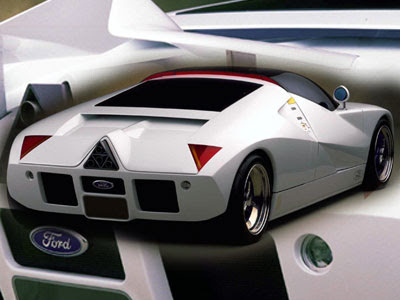
2010 Ford GT90 Super Sport Car Concept

The one-off GT90 Concept Car, labeled immediately as "the world's mightiest supercar" by Ford Motor Company on December 6, 1994, was the spiritual successor to the Ford GT40, the product of a colossal feud in the early 1960s between the Blue Oval from Dearborn and the Prancing Horse of Northern Italy. The GT90 draws from the design cues of its heritage and pays homage to the famed Le Mans-winning Ford GT40s of the 1960s, which were created after the failed attempt by Ford to buy out Ferrari.
At a development cost in the neighborhood of $3 million, the GT90 was certainly worthy of pulling styling cues from the original Ford GTs, and although it was never meant for production, it was built according to a Ford press release as a "test bed for technology, engineering and design concepts, and driver-oriented features that eventually may be used in Ford production vehicles."
Officially unveiled to the public in January 1995 at the Detroit Auto Show, the GT90 is finished in bright white with a bright blue and carbon fiber interior. It features a mid engine quad-turbocharged V12 that produces an estimated 720 horsepower and 660 pound-feet of torque. As a result, it had a claimed top speed of 253 mph, which even by today's standards would make it one of the fastest production cars in the world – faster even than a McLaren F1, which was widely considered the world's preeminent supercar at the time.
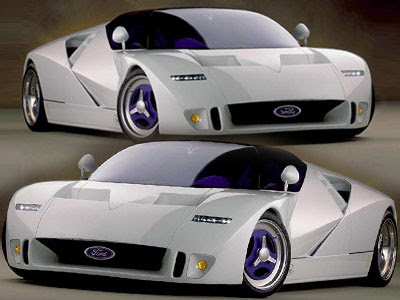
2010 Ford GT90 Super Sport Car Concept

The engine, which was a 48-valve six-liter V12, had to be combined together with four Garrett Systems T2 turbochargers in order to reach its estimated 720 horsepower and was based on the Ford Modular engine. Created by using parts of two Lincoln V8 engines, engineers removed the last pair of cylinders from the rear of one engine and the first pair of cylinders from the front of the other engine. The cut-down engines were then welded together with the final result being a 90-degree V12, which utilized a 90.2 mm bore and a 77.3 mm stroke to achieve maximum power.
The GT90 features the FFD-Ricardo five-speed manual gearbox found on the XJ220 and, considering the torque load that it is designed to handle, is noted as having a relatively light shift quality. Also borrowed from the XJ220 comes the all around double wishbone suspension that was designed to enable the car to handle well at top speeds.
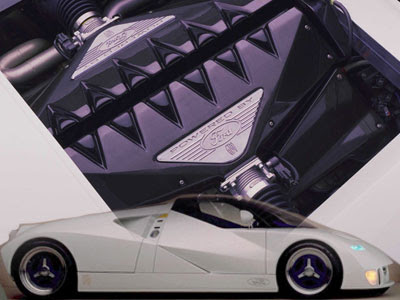
2010 Ford GT90 Super Sport Car Concept

Using Ford's new "Edge" design philosophy, the car incorporated advanced technology with a mixture of flat planes, angles, glass and triangular shapes that seemingly all collided together. The GT90 was the first car created using this new styling directive from Ford, which went on to be responsible for the creation of other Ford products like the Ka and Cougar. The effect is most impressive and a wonderfully executed stylistic throwback to its GT40 predecessor, which at once stays true to its heritage but acknowledges the advances in modern design. Taken directly from race car technology, the GT90 body panels are molded out of carbon fiber while the chassis is formed out of a honey-comb sectioned aluminum monocoque.
The GT90 is a test bed of advanced technology and design. It sports a tinted, laminated glass bubble over the cockpit and a spoiler that rises off the rear deck at high speeds. According to Ford, it has a "design that tightly enclosed its mechanicals with no wasted space; high tech lighting and blind-spot detection systems; and tiles like those on the space shuttle to shield the V12's exhaust outlets."
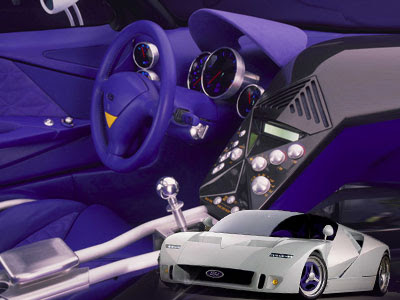
2010 Ford GT90 Super Sport Car Concept

After its unveiling in Detroit, the GT90 made its rounds on the Auto Show Circuit in 1995, traveling around the world to Frankfurt and as far away as Tokyo. With few other showings in between, the car recently was shipped over to Europe to be on display in the Ford of Europe 2008 exhibit at the Goodwood Festival of Speed. After returning home, the car was shipped to Alabama where it was on display as part of the Mustang 45th Anniversary Celebration.
This superb concept car remains in excellent running condition, having been properly stored and maintained over the years in between its show appearances. RM Auctions is proud to publicly offer the GT90 for the first time ever at auction. A remarkable one-off piece of automotive history and cutting-edge design, its offering may very well be a once in a lifetime opportunity for Ford devotees and concept car enthusiasts.
READ MORE - 2010 Ford GT90 Super Sport Car Concept going to auction

Wednesday, January 5, 2011

2010 Hamann Super Sports Cars Victory II

2010 Hamann Super Sports Cars Victory II
German tuning house Hamann, Hamann Victory is presented based on the super sports cars Lamborghini Gallardo first, and its latest projected, dubbed the Victory II, is a prime example.
Based off the Lamborghini Gallardo LP560-4, the 2010 Hamann Super Sports Cars Victory II features a completely new look thanks to all new body panels, functional roof inlet, rear wing and 20-inch Hamann wheels. The car body becomes broader and the engine performance as well as the amount of carbon parts is significantly increased.
2010 Hamann Super Sports Cars Victory II
Hamann car equips the Victory II with 20 inch Edition Race rims with a special varnish in order to emphasize the new dynamic look. At the same time, the reduced unsprung masses improve the handling and the acceleration and braking response. The recommended wheel/tyre combination is 9.5Jx20 inches with 235/30ZR20 tyres at the front and 13Jx20 rims with 325/25ZR20 tyres at the back.
The back of the car is enhanced by a diffuser and a newly designed rear wing which pushes the car onto the road at high speeds. Hamann offers the rear wing either in fibre glass or the ultra light and persistent carbon. On top of that, a carbon layer can be applied to the bonnet.
With the LP560-4 already producing 552 bhp and 398 lb-ft torque, Hamann decided to do only minor modifications to the 5.2L V10. New engine programming results in 20 more horsepower and an additional 26 lb-ft, resulting in a new top speed of 204 mph. Therefore, the 2010 Hamann Super Sports Cars Victory II reaches an impressive 328 km/h top speed. The impressive V10-Sound turns even more remarkable by applying an end muffler to the serial end pipes.
2010 Hamann Super Sports Cars Victory II
The interior of the 2010 Hamann Super Sports Cars Victory II is enhanced by a 14-part carbon set which includes decorative blends, the steering wheel and the door openers. The Hamann-sports seats with the carbon back render a perfect seating position.
2010 Hamann Super Sports Cars Victory II
READ MORE - 2010 Hamann Super Sports Cars Victory II

Tuesday, January 4, 2011

2010 BMW Sports Cars Z4 GT3

2010 BMW Sports Cars Z4 GT3
The German company BMW has been considered as one of the top manufacturers ever since it was first introduced in 1916, they have been an expert when it comes to creating new and innovative vehicles to cater to the market. GT3 BMW Z4, which is officially launched and completed the first test drive in early March, already enjoying great popularity among customers of BMW Motorsport. The first cars delivered to private teams, BMW will prepare them for use in national and international championships.
2010 BMW Sports Cars Z4 GT3
BMW Z4 production model is impressive: with a long hood, wheel arches are lit, the long wheelbase and narrow projection, this car offers a unique look. BMW Motorsport engineers two passengers provide a good basis to develop close to GT3 racing car production.
“Information about the 2010 BMW Sports Cars Z4 GT3 very positive,” said BMW Motorsport Director Mario Theissen. ‘Round these sports cars in the range of our products, and provides drivers and teams a chance to compete at the championships in accordance with the GT3 regulations – such as the FIA GT3 European Championship, the International GT Open or Masters ADAC GT – and 24-hour endurance races." In addition, the BMW M3 GT2, the BMW 320si WTCC, which complies with Super2000 regulations, and the close-to-production BMW M3 GT4 are also available to customer teams from all over the world at BMW Motorsport Distribution.
2010 BMW Sports Cars Z4 GT3
The largest difference between production and racing car can be found under the bonnet: while the production version of the BMW Z4 is driven by a six-cylinder engine, the GT3 car is powered by a 4.0-litre eight-cylinder engine similar to the unit used in the BMW M3 GT2. This powerful heart produces over 480 bhp. Its excellent performance characteristics and good torque curve make the base engine from the production version of the BMW M3 predestined for use in motorsport.
Front and rear wings, bonnet, roof, fender and many other components are made of carbon fibre reinforced plastics (CFRP). Using this lightweight, torsion-resistant material contributed significantly to reducing the weight of the 2010 BMW Sports Cars Z4 GT3 to 1,200 kilograms. As with all cars in the BMW customer racing range, the emphasis was also put on cost-efficiency when developing the 2010 BMW Sports Cars Z4 GT3. As a result, the car offers an excellent cost / quality ratio and gives the team a chance to participate personally in the affordable sports car at the highest level.
2010 BMW Sports Cars Z4 GT3
The BMW Z4 GT3 is available as a racing version is available from the second quarter of 2010 at an estimated price of 298,000 Euro (plus VAT).
READ MORE - 2010 BMW Sports Cars Z4 GT3

Thursday, November 18, 2010

Brabus E V12 Coupe, 2010

Brabus E V12 Coupe, 2010


At the Geneva Motor Show 2010 the Brabus E V12 Coupe celebrates its world debut as the world's fastest Gran Tourismo. Based on the new Mercedes E-Class Coupe, Brabus builds a luxurious 2+2-seater in small-series production. It is powered by a Brabus SV12 R Biturbo 800 twelve-cylinder displacement engine that produces 800 hp (788 bhp) / 588 kW of power and a peak torque of 1,420 Nm (1,047 lb-ft). Brabus accepted by the German Federal Vehicle Registration Agency (Kraftfahrtbundesamt) as an automobile manufacturer, offers this high-performance automobile capable of reaching speeds in excess of 370 km/h (230 mph) starting at 478,000 Euros MSRP.

Like the fourth-generation Brabus E V12 sedan the new E V12 Coupe is powered by a Brabus SV12 R Biturbo 800 displacement engine. Drawing upon decades of experience in developing and building high-performance vehicles the twelve-cylinder engine was fitted into the engine bay of the two-door E-Class.

The basis for this engine is the twelve-cylinder twin-turbo engine from the latest Mercedes 600 models. Displacement of the engine is increased from 5.5 to 6.3 liters (336 to 384 cu. in.) with the help of a special crankshaft, larger cylinder bore and correspondingly larger pistons. Both three-valve cylinder heads are optimized for mixture flow, and fitted with sport camshafts.
Underneath the custom-made hood with integrated carbon-fiber RAM airbox is space for a completely newly developed air intake system. This twin-turbo system was designed from the ground up for the new E V12 generation. It includes two custom high-performance headers with integrated turbochargers and four water-to-air intercoolers. The stainless-steel high-performance exhaust system with free-flow metal catalysts was also custom-tailored for the confined space under the E-Class Coupe.
In addition, the Brabus engine specialists have developed a precision engine management system that controls injection, ignition and driving dynamics systems. The result is an optimal combination of impressive power yield and eco-friendly emissions that meet strict EURO IV exhaust limits.

The Brabus SV12 R Biturbo 800 engine is lubricated with high-tech motor oil from technology partner ARAL. It produces a rated power output of 800 hp (788 bhp) / 588 kW at 5,500 rpm. The even more impressive peak torque of 1,420 Nm (1,047 lb-ft), available already at a low 2,100 rpm, is limited electronically to 1,100 Nm (811 lb-ft).

Power is transferred to the rear wheels via a reinforced five-speed automatic transmission and a Brabus high-performance limited-slip differential. The Brabus E V12 comes standard with state-of-the-art driving stability programs that can be deactivated at the push of a button.

Performance of the coupe is as exceptional as that of the four-door model: The Brabus E V12 Coupe sprints from 0 - 100 km/h (62 mph) in just 3.7 seconds, to 200 km/h (124 mph) in 9.9 seconds, and reaches 300 km/h (186 mph) after a mere 23.9 seconds. For street-legal use the top speed of the Gran Tourismo is limited electronically to 350 km/h (217 mph). Without the limiter the two-door twelve-cylinder car is capable of speeds in excess of 370 km/h (230 mph).

This extreme performance also places highest demands on the vehicle's aerodynamic properties. The Brabus designers went into the wind tunnel to develop a body conversion kit made from high-strength yet especially lightweight carbon fiber. The kit combines sporty design and aerodynamic efficiency to perfection.

The Brabus front was designed to reduce lift on the front axle and to provide all radiators of the V12 with an optimal supply of cooling air. Air outlets in the sides route the air quickly away from the heat exchangers. Another important design feature was to provide the front brakes with cooling air. Integrated LED daytime running lights further increase active safety.

A wider track means better directional stability at high speeds. Because of that Brabus has developed special carbon-fiber sport fenders with integrated air vents for the front axle. Special carbon-fiber rear fenders add 60 millimeters (2.4 in.) to the width of the coupe on the rear axle. The Brabus E V12 Coupe runs on especially wide wheels fitted with high-performance tires from Pirelli or YOKOHAMA. The 19-inch combination is perfect for the enormous top speed the car is capable of. The wheels are 9.5 inches and 10 inches wide and customers can choose from Brabus Monoblock designs VI, E, Q and S. Tires in size 265/30 ZR 19 are mounted on the front axle. Size 285/30 ZR 19 tires on the rear axle provide optimal traction.

Rocker panels with integrated illuminated Brabus logo and LED entrance lights route the air stream along the sides with minimum turbulence. They also lend the two-door car a longer, sleeker appearance.

The Brabus rear apron with carbon-fiber diffuser features a centrally mounted reflector and custom-tailored cutouts on either side for the Brabus quad sport exhaust system. The Brabus rear spoiler is essential for well-balanced aerodynamics at high speed.

To make the Brabus E V12 Coupe not only a superior road warrior but upon request also an extremely sporty racer on the track the suspension was completely redesigned. The redesign includes special suspension components on front and rear axle that offer a wider range of individual suspension settings.

These measures are complemented by a Brabus coil-over suspension that features a multitude of selectable settings for bound and rebound. The shock absorbers on the front and rear axle feature ten selectable settings for bound and rebound. The ride height has an adjustment range of 35 millimeters (1.4 inches). Sport sway bars can further minimize body roll during fast cornering.

The Brabus high-performance brake system meets the toughest demands, on the road or on the track. The front axle features 12-piston aluminum fixed calipers and vented and grooved steel brake discs measuring 380 x 37 millimeters (15.0 x 1.5 inches). The rear axle stops on six-piston aluminum fixed calipers gripping discs measuring 360 x 28 millimeters (14.2 x 1.1 inches). The Brabus high-performance brake system incorporates all functions of the standard Brake Assist system of the Mercedes E-Class.

The interior combines sporty character with luxurious ambiance. An ergonomically shaped sport steering wheel is part of the equipment list of the Brabus E V12 Coupe as are sport seats upholstered with the finest leather. The seats provide excellent seating comfort and lateral support.

Genuine carbon-fiber trim on dashboard, center console and doors adds further sporty highlights.

READ MORE - Brabus E V12 Coupe, 2010

Sunday, October 31, 2010

2010 LUXGEN Cars New Luxgen7 SUV 2.2-litre Turbocharged

2010 Luxgen7 SUV is model that’s on sale in its home market and if it proves successful, could eventually make its way to the UK and other European countries. It is Taiwan’s first passenger automobile brand Luxgen. The Taiwanese auto brand, Luxgen, has lifted off the covers from its second model, the very new Luxgen7 SUV that according to the maker, “represents a milestone in vehicle design.” The company’s first model was called the LUXGEN7 MPV and received tremendous response in sales and became the first automobile ever to win the prestigious Taiwan Excellence Award. Now with Luxgen7 SUV, the company seems to be scripting another success story.
2010 LUXGEN Cars New Luxgen7 SUV
The 2010 Luxgen7 SUV represents a milestone in vehicle design. The distinctive wing shaped chrome nose trim and cascading grille express both power and confidence and upward sweeping beltlines convey a sense of dynamics motion as well. Measuring at 4.8 meters long, 1.93 meters wide and 1.76 meters in height, the LUXGEN7 SUV is also among the largest in its segment while maintaining elegant and svelte proportions.
LUXGEN7 SUV is also the only one in its segment to feature the intelligent power actuated tailgate as standard equipment. Another exclusive feature in the car is the anti-theft sport seat. The company explains the working in the following statement: “When drivers press the button on the anti-theft seat for three seconds before locking the doors with the remote control, the anti-theft system will activate by sliding itself forward and leaning against the steering wheel to deny unauthorized access of the vehicle.”
The Luxgen7 SUV powered by a newly developed 2.2-litre turbocharged four-cylinder petrol engine producing 175HP at 6,000rpm and 28kgm of torque spanning from 2,500 to 4,000rpm. The petrol unit is coupled to an also new 5-speed automatic transmission equipped with manual shifting function and what Luxgen describes as “intelligent Transmission Control Module with 10 built-in operation modes.” The automatic transmission was developed by Japan’s Aisin.
The Luxgen7 SUV interior design uses the premium leather seat with airline first class style surrounding head restraints together with the available heating, ventilation, electronic and lumbar support adjustment functions to ensure utmost comfort anytime. In addition, the Hi-end Clarion audio system and JBL speakers provide premium sound quality and surreal vocal reproduction to music lovers.
In the interior, the luxury Luxgen7 SUV features Hi-end Clarion audio system with JBL speakers, GPS navigation, four advanced visual assistance systems including Eagle View and many more. In the security system, however, there is SRS airbags, ABS Antilock Braking System, BAS Braking assistance System and EBD Electronic Brake Distribution. The potential buyers have to shell out somewhere between US$25,831 to 35,386 to own a Luxgen7 SUV.
Inside the Luxgen7 SUV you will find premium leather seat available with heating, ventilation, electronic massage and lumbar support adjustment, as well as Hi-end Clarion audio system and JBL speakers. The safety features dual front SRS airbags, Antilock Braking System, Braking Assistance System, and Electronic Brake Distribution system. Furthermore, dual side protection airbags, dual side curtain airbags, Electronic Stability Control, and Traction Control System are also available options.
In addition, the SUV also gets an intelligent 3-mode 4WD system that can actively split engine torque between the front and rear axles based on the road condition and driver input. In Taiwan market, the Luxgen7 SUV is available in five trim levels at prices ranging from NTD 838,000 ($25,831 U.S.) to NTD 1,148,000 ($35,386 U.S.).
READ MORE - 2010 LUXGEN Cars New Luxgen7 SUV 2.2-litre Turbocharged

Monday, October 25, 2010

Alfa Romeo Sport Cars Autodelta Alfa Romeo 8C Competizione

The Performance Car Show that will take place in Birmingham, UK, 14-17 January 2010, Autodelta will unveil the world’s first tuned Alfa Romeo 8C Competizione. Alfa Romeo’s awesome Alfa 8C Competizione supercar has scooped the award for Best Design of the Year in Auto Express’s 2008 New Car Honours.
The announcement came after more than 4000 Auto Express readers voted in the category, putting the Italian 4.7 V8 head and shoulders above its rivals.  Auto Express’s judging panel agreed with their verdict.
Editor of Auto Express, David Johns, said: “Choosing the best designed cars of the year is never easy, so we turned to the experts for help – Auto Express readers.  Only one car was ever going to win – Alfa Romeo’s  Sport Cars 8C Competizione simply blew the opposition away.”
Alfa Romeo Sport Cars Autodelta Alfa Romeo 8C Competizione 
Marketing Director of Alfa Romeo UK, Nicholas Bernard, added: “It’s fabulous to know that this supercar has stirred the emotions and unified car fans across the UK.  It is the epitome of the Alfa Romeo Sport Cars marque and will provide the design inspiration for future models.”
The 4.7-liter V8 engine in the car masterpiece is obviously a slightly higher performance using a new engine management software. The engine develops 444 hp at its plant stock and Autodelta incarnation promises to 17 more to offer. Technical refinements to the chassis of the car and the suspension was also promised, but no further details were released by the company.
Few details are known at this point, but a remapped ECU should squeeze out a modest 17 horsepower boost from the stock 444-hp, 4.7-liter Ferrari-developed V8. Alfa Romeo Sport Cars Autodelta Alfa Romeo 8C Competizione is also working on fine-tuning the chassis, taking their 8C around some of the finest tracks in Europe to get it just right.
Alfa Romeo Sport Cars Autodelta Alfa Romeo 8C Competizione
Autodelta also announced that they are working on chassis and suspension upgrades that will be presented at a later date.
READ MORE - Alfa Romeo Sport Cars Autodelta Alfa Romeo 8C Competizione

Sunday, October 17, 2010

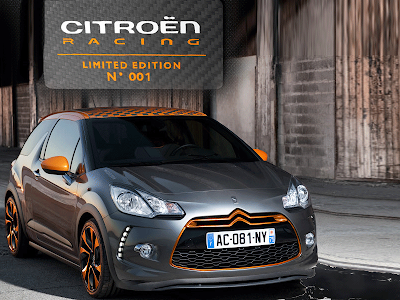
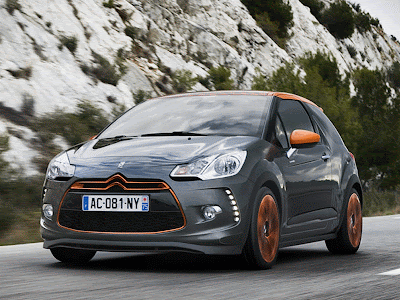
2010 Citroen DS3 Racing Car Limited Edition

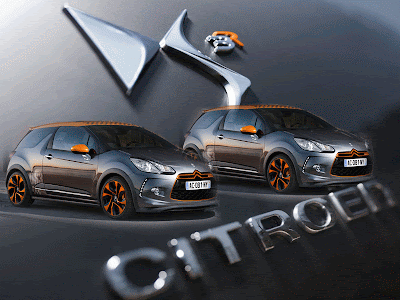
Citroen plans to unveil a limited edition of the Citroen DS3 next month at the Geneva Motor Show. The Citroen DS3 Racing is a suped up version of the company's luxe supermini. While only 1000 units will be built, Citroen Australia General Manager, Miles Williams said that local availability for the special DS3 Racing will be announced when the regular DS3 launches in August.
2010 Citroen DS3 Racing Car Limited Edition
“The Citroen DS3 Racing represents an outstanding concentration of behind-the-wheel thrills with an artful blend of performance and efficiency. The DS3 Racing provides a clear indication of what we can expect when the DS3 arrives in Australia in August.” Mr Williams said.
2010 Citroen DS3 Racing Car Limited Edition
Developed by Citroën Racing - the winning team behind five WRC manufacturer's titles and six driver's titles for Sébastien Loeb and Daniel Elena - Citroën DS3 Racing is a special edition with a 100% sporting pedigree. Planned for the second half of 2010, the exclusive Citroën DS3 Racing will be limited to just 1000 production units.
2010 Citroen DS3 Racing Car Limited Edition
As such, the car's output has been bumped up by 30% to 200 PS (147 kW / 197 hp) using the turbocharged 1.6-liter THP engine. Torque is improved by 15% to 275 Nm (203 lb-ft). These changes were achieved by remapping the engine control unit, adjusting the turbo, and adjusting powertrain components.
2010 Citroen DS3 Racing Car Limited Edition
Meanwhile, stiffer suspension springs and new shock absorbers are also installed. The car has been lowered by 15mm, while both the front and rear track were widened by 30mm. Along with the new tires wrapped around the 18-inch wheels, the changes "all dramatically change the driving dynamics," according to a press release.
2010 Citroen DS3 Racing Car Limited Edition
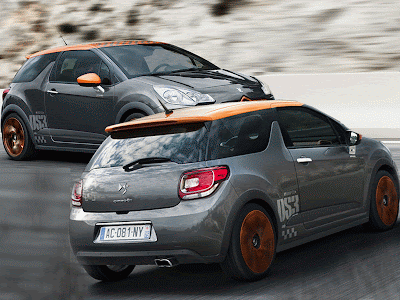
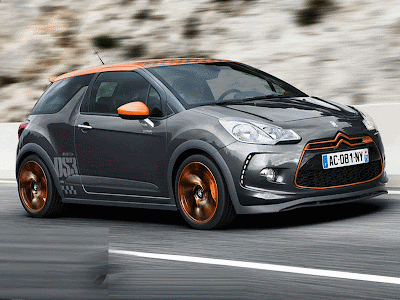
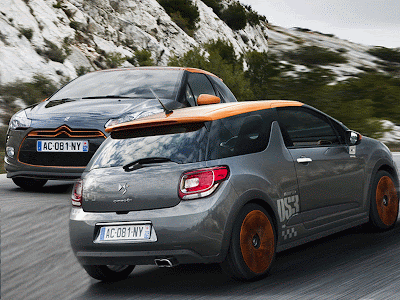
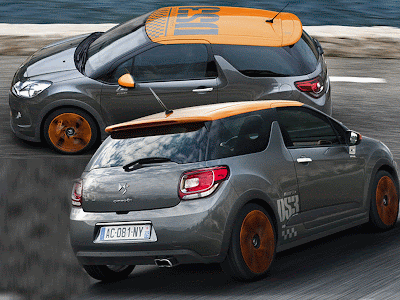
To handle the extra power, the company installed four-piston caliper brakes up front and ventillated discs in back. Carbon-fiber touches are used on the new air diffuser, front bumper, lower body, and wing extensions. Chrome is also used at certain points, like the door handles and exhaust, with orange tint on the calipers, grille, roof, side mirror caps, and wheels. Inside, designers added carbon trim and orange inserts. Purposeful sport seats were also installed.
A Citroën DS3 Racing signature on the rear tailgate and an individually numbered identification plate fixed to the roof-lining further confirm the model's exclusivity.
2010 Citroen DS3 Racing Car Limited Edition
At 3.94-meters long, the grey and orange car will be shown in Geneva with checkered flaq and DS3 Racing graphics. Based on the existing DSport powered by the THP 150, production Citroën DS3 Racing editions will be finished in a special workshop and fitted with a parts kit developed according to Citroën Racing specifications. Only 1000 units of the Citroen DS3 Racing will be produced. The car will be released in the second half of 2010.
READ MORE - 2010 Citroen DS3 Racing Car Limited Edition

Friday, October 15, 2010

2010 Aston Martin DBS Edo Competition Luxurious Sports Car

Edo Competition Aston Martin DBS is a result of a modification carried out by Edo Competition Motorsport for the 12-cylinder Aston Martin that already produces 517 horsepower and has a top speed of more than 300 km/h (186 mph). Improving and underlining the elegance and beauty of this British triumph and strengthening its sporting character was the goal declared by Edo competition.
2010 Aston Martin DBS Edo Competition
The first step taken by Edo Competition was improving the power output. The DBS’s engine control unit was modified via software recalibration, then supported by a new high performance exhaust system, and was fitted with special catalytic converters and high flow air filters. As a result, the DBS’s power output was increased from 517 hp and 570 Nm (420 ft-lb) to 550 hp and 600 Nm (442 ft-lb), an enough power to accelerate from 0 to 100 km/h (62 mph) in 4.1 seconds and continue on to a top speed of 320 km/h (199 mph).
The high performance exhaust system, which was specially designed for the DBS, incorporates butterfly valves allowing it to produce a fantastically rich and sonorous sound. They further help increase the British luxury sports car coupe`s power and torque output. The exhaust comes with a programmable control system that monitors backpressure inside the exhaust and opens the 70 mm butterfly valves when a pre-determined level of backpressure is exceeded.
The unique advantage of this system is that it provides good torque at low engine speeds without sacrificing top end horsepower. The exhaust system is made from stainless steel and the chromed exhaust tips accentuate the elegant design. The driver can adjust the sound of the DBS at any time using a remote control.
Dealing with the levels of grip, Edo competition offers a new wheel design, a set of 21 inch racing wheels. The three-piece wheels come with stainless steel outer rims and the customer can choose the stock tire dimensions
Further, Edo competition has developed a new high performance brake system, 405 mm rotors with 6-piston monoblock calipers and performance brake pads for the front and 380 mm rotors with 6-piston monoblock calipers and performance brake pads for the rear, both including braided stainless steel brake lines.
As with all edo competition models, we set no limit to our customers` imaginations. Special interiors or lavish leather upholstery, individual requests are accommodated and executed with quality.
The modifications of this Edo competition Aston Martin DBS are all carried out at Edo competition Motorsport GmbH in Ahlen, Germany.
READ MORE - 2010 Aston Martin DBS Edo Competition Luxurious Sports Car

LinkWithin

Related Posts Plugin for WordPress, Blogger...